Understanding the Distress of King Saul: A Study in 1 Samuel 16
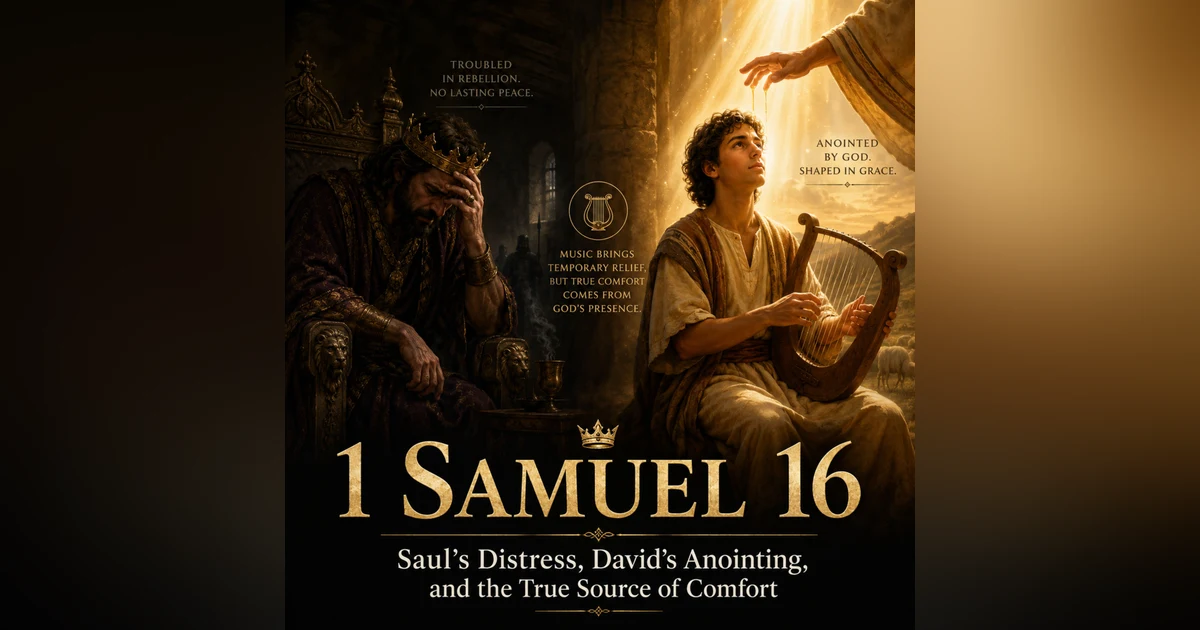
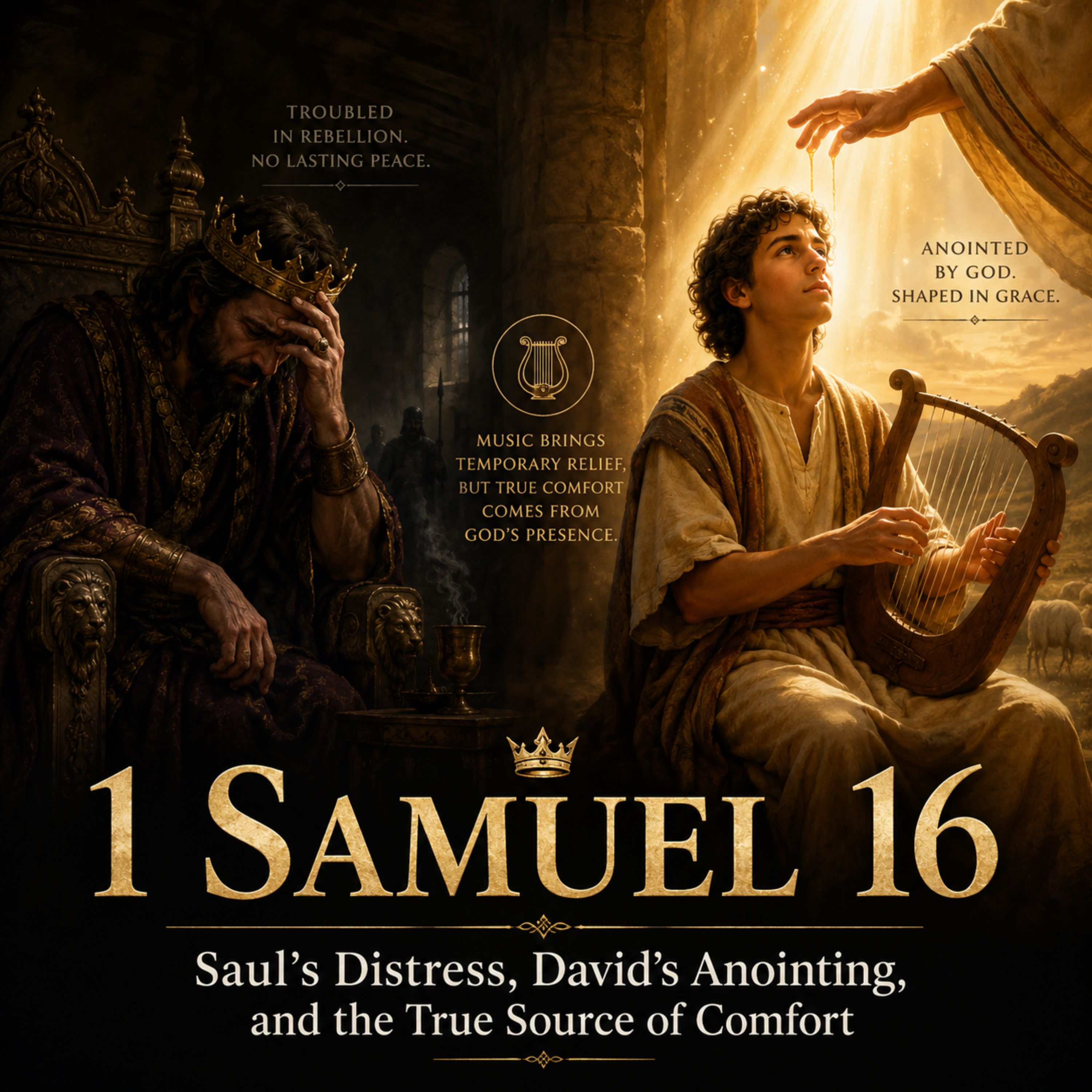


The episode delves into the profound narrative found in 1 Samuel chapter 16, focusing on the contrasting figures of King Saul and David. The central theme revolves around the spiritual distress afflicting Saul, attributed to his disobedience and the subsequent departure of God's Spirit from him, resulting in turmoil and inner conflict. In juxtaposition, David, who has been anointed by God, embodies a heart aligned with divine will, receiving the Spirit and thus experiencing God’s sustaining presence. The discussion highlights the critical distinction between seeking temporary relief through external means, such as music, and finding true comfort in a relationship with God. Ultimately, I assert that genuine peace arises not from external circumstances but from the abiding presence of the Lord in one's life, an essential truth for all believers navigating their spiritual journeys.
Takeaways:
- The narrative in 1st Samuel chapter 16 illustrates the stark contrast between King Saul and David, highlighting their differing relationships with God.
- Saul's distress arises from the departure of God's spirit due to his disobedience, leading him to seek temporary relief rather than genuine repentance.
- David's anointing signifies God's selection and the presence of His spirit, empowering him to fulfill God's purpose despite his youth.
- The episode emphasizes that true comfort comes from a relationship with God, rather than merely seeking distractions through temporary means.
- The message underscores the importance of recognizing God's holiness and understanding that He does not cause evil, but allows it as a consequence of human choices.
- Finally, the comfort we receive from God is meant to be shared with others, showing the communal nature of faith and support within the Christian community.
Thank you for joining our podcast. Visit our website at https://middletownbaptistchurch.org/
Subscribe to our YouTube at https://www.youtube.com/@middletownbaptistchurchde5091
Follow us on Facebook https://www.facebook.com/MBCDelaware
This podcast is produced by Ralph Estep, Jr., host of Financially Confident Christian, a daily podcast on Christian Finance you can find it at https://www.financiallyconfidentchristian.com
00:00 - Untitled
00:14 - The Distress of King Saul
01:09 - The Contrast of Kings: David and Saul
09:33 - Understanding God's Holiness and Human Responsibility
17:02 - The Introduction of David
27:31 - The Role of Comfort in Spiritual Leadership
29:43 - The Comfort of God in Distress
41:04 - The Distinction of the Holy Spirit in Our Lives
Well, let's go ahead and continue our study in 1st Samuel.
Speaker AIf you have not been with us, we've been tracking through First Samuel for some, quite some time now.
Speaker AAnd we're in chapter 16, and we're going to be talking tonight about a very interesting topic.
Speaker AWe're going to see King Saul, and we're going to see that there's an evil spirit that troubles him, and he's going to come to a place of distress, and we're going to look at the source of that distress.
Speaker AAnd oftentimes there's some confusion in this passage or we're also going to see a contrast between David, who just got anointed king in the first part of First Samuel, chapter 16.
Speaker AIf you remember, God said earlier on in this study that, Saul, you've missed your opportunity because of your bad decisions, because of your selfishness, because of your pride, because of your disobedience.
Speaker AYou've lost the blessing of being king and the throne is going to be taken out of your family line.
Speaker AAnd remember what God said.
Speaker AHe said that he would select a man after his own heart.
Speaker ASo we're going to see the difference between David and Saul.
Speaker AAnd.
Speaker AAnd really the main difference is their heart in accordance to God.
Speaker AAnd so where we left off last week, we'll pick up where we left off.
Speaker ASamuel anoints David as king.
Speaker AAnd that oil that is anointing on David's head, that is a picture of God's selection and upon God's power and wisdom and discernment upon David and his control over David.
Speaker ABut we see in verse 13, it says, then Samuel took the horn of oil and anointed him in the midst of his brethren.
Speaker ASo this was not a public thing in all of Bethlehem.
Speaker ARemember David's from Bethlehem.
Speaker AAnd so not everybody sees this, but at least David's family sees this.
Speaker AAnd it says something very interesting here because this is what's going to be contrasted with verse 14 with Saul's heart.
Speaker ASo it says with this obedience and with this selection from God, it says the Spirit of the Lord came upon David from that day forward.
Speaker AAnd so think about this.
Speaker AThink about in David's life, though he's not perfect, the Spirit of God is upon him.
Speaker AAnd it's there because of his heart and his relationship with God.
Speaker AIt's there through faith.
Speaker AAnd then we're going to see in contrast to that, a guy named Saul, King Saul.
Speaker AHis heart was not in obedience to the Lord.
Speaker AHe does not have a heart of faith.
Speaker AAnd because of that, we're going to see him in a great place of distress.
Speaker AWe're going to see him in a place of turmoil.
Speaker AWe're going to see him in a place that he doesn't have the comfort of God.
Speaker AAnd the Bible very clearly teaches that the Spirit of God, when he's in our life, brings us comfort.
Speaker AActually, one of the titles of the Holy Spirit in the New Testament in the Book of John is that he is the comforter.
Speaker AAnd there's so many people in the world today that are looking for comfort.
Speaker AAnd obviously we.
Speaker AWe have in America a lot of things of comfort.
Speaker AAnd really, comfort is set as a premium.
Speaker ABut what's happening in our world today, and what we're even going to see back in the time of Saul is that the comfort was not a comfort, that God promises, that sustaining comfort.
Speaker ABut most of the time, people in the world are searching after a type of comfort that can only temporarily satisfy.
Speaker AAnd so that's what we're going to see here in First Samuel chapter 16.
Speaker AAnd it's so appropriate that we sing that hymn tonight, Holy, Holy, Holy.
Speaker ABecause that's going to be at the source of our conversation here this evening.
Speaker ABecause some people read this passage in 1st Samuel chapter 16 and think that God actually sends evil to Saul.
Speaker AAnd if you read it, at first glance, it might even seem that way.
Speaker ABut when we understand the character of God and the holiness of God and what the New Testament tells us about temptation and about distress, we're going to see that it's not the source of evil from God, but.
Speaker ABut it's certainly God allowing evil to come into Saul's life.
Speaker AAnd so look at verse number 14 with me in 1st Samuel, chapter 16, it says, but the Spirit of the Lord departed from Saul.
Speaker ANow remember where we left off, okay?
Speaker ASamuel anoints David.
Speaker AThe Spirit of God comes upon David.
Speaker ABut in verse 14, we see because of Saul's disobedience, the Lord departs from Saul.
Speaker ANow, you have to also remember in the Old Testament that the Holy Spirit works differently than today.
Speaker AToday, we believe that believers, when they're saved, there's that eternal sealing of the Holy Spirit.
Speaker AThe Bible tells us that in the book of Philippians, there's other passages like Romans 8 and others that speak of that eternal security that we have in Jesus Christ and the fact that a believer is indwelled by the Spirit, that spirit's not going to leave us.
Speaker ABut in the Old Testament, we would see instances where the Holy Spirit would come upon individuals and then also leave individuals.
Speaker AAnd so in this case, we see David is being indwelled, or as it says, this anointed comes upon him and the Holy Spirit comes upon David.
Speaker ANow we're going to see Saul have the spirit depart, and then we actually see what comes in that place.
Speaker AIt says, in an evil spirit from the Lord troubled him.
Speaker ANow, some commentators read that verse and would say, well, now it's God sending this evil upon him.
Speaker AIt's actually God causing Saul to be evil.
Speaker AAnd there's a lot of different ways that we could look at this.
Speaker ABut I want us to have some level of clarity in understanding the context of Scripture and understanding the way that God works and then going from there and kind of understanding how this would look in the life of Saul and how it could look in our own lives to some degree when it comes to the distress that certain people might face today.
Speaker ASo let's look at verse number 14 again.
Speaker AIt says, the Spirit of the Lord departs from Saul.
Speaker ASo to some degree, we see that God removes his presence in the life of Saul.
Speaker AAnd in God removing his presence from Saul, we see that something comes on the scene, an evil spirit comes from, as it says here, from the Lord to trouble him, or another way that you could say that is distress him to cause anxiety, to cause inner turmoil.
Speaker AAnd so from first glance that might look like, well, God's causing this evil.
Speaker ASaul had no choice but go with me to the Book of James, because we're going to stick our finger there in First Samuel, chapter 16.
Speaker AAnd let.
Speaker ALet's look at what the Bible says in the Book of James about when an individual blames God for his or her sin.
Speaker ABecause there's actually times in my life and maybe your life that you've heard people say, well, God made me do it, or God made me this way.
Speaker ASo why would God hold me accountable if God is the one that's sending the evil?
Speaker AMaybe someone even says, well, you know, maybe God didn't make me do it, but maybe you've heard this, the devil made me do it.
Speaker AOr maybe you even heard this.
Speaker AI heard a guy on a live stream recently.
Speaker AHe was a preacher, and I think I might have shared this in church at one point, this guy was doing a live stream, and he was.
Speaker AHe didn't know he was on live stream.
Speaker AHe.
Speaker AHe didn't know he was even being filmed.
Speaker AAnd he treated a waitress at this live like he was at a restaurant, and he was gonna film this live stream.
Speaker AAnd he treats this waitress terribly.
Speaker AHe, like, belittles her and yells at her, and then he Finds out he's on camera and he says, and this guy claims to be a pastor.
Speaker AAnd he goes, oh, don't.
Speaker ADon't show that.
Speaker AAnd they're like, that's live stream.
Speaker AThat's on live.
Speaker AAnd he goes, well, let me show you this.
Speaker AThis is a way that someone can be a stumbling block to you and lead you to sin.
Speaker AAnd I'm like, no, you can't blame someone for your sin.
Speaker ASo James, chapter one tells us right here in verse 13, James 1:13, let no man say when he is tempted, I'm tempted of God.
Speaker ASo.
Speaker ASo God is not the causer of the temptation.
Speaker AHe's not the one who brings that evil into our life.
Speaker ASo who do we have to blame?
Speaker AWell, maybe it's Satan.
Speaker AMaybe it's another person.
Speaker AIt's not God.
Speaker AWell, it says here, for God cannot be tempted with evil, neither tempteth he any man.
Speaker ABut every man is tempted when he is drawn away of his own lust and enticed.
Speaker ASo what the Bible tells us in verse 14 is that there's no one to blame but ourselves.
Speaker ANow, there could be outside forces that certainly give us an opportunity to make a decision on whether or not we're going to give into that temptation.
Speaker ABut what we see here is he says in verse 14, the book of James, that it's our fault when we sin.
Speaker AWe can't blame anybody else, we can't blame God, we can't blame another person, we can't blame the devil.
Speaker AIt's upon us and our responsibility to make a decision not to fall into sin, not to fall into this place of inner turmoil.
Speaker ANow, that turmoil can come, but it's how we deal with that temptation, right?
Speaker ABecause we know that temptation in and of itself is not a sin.
Speaker AHow do we know that?
Speaker ABecause Jesus was tempted.
Speaker AAnd so temptation is not the sin.
Speaker AIt's giving into that.
Speaker ASo what we see in verse number 15, he goes on to describe how this all comes to pass.
Speaker AHe says, then when lust hath conceived.
Speaker AAnd actually the picture here in verse number 15, you might not be able to see it here in the English, but in the Greek, there actually is a picture of a birth happening.
Speaker AWe actually see that, that word, it says in verse 15, when lust have conceived.
Speaker ABut in that conception of sin, it's not going to bring forth life.
Speaker ABecause a lot of times people think that this sin is going to bring me something good, it's going to bring me something that's a blessing.
Speaker ABut actually what we see here is that it's actually bringing Forth a stillborn death.
Speaker ASo he says, when lust, so this lust is that.
Speaker AThat passion, that desire to do something.
Speaker AIt says when that's conceived, it bringeth for sin.
Speaker AAnd so temptation is here.
Speaker AWe decide to give in in our lust, and then that's what's conceived in sin.
Speaker AAnd it says it brings forth sin.
Speaker AAnd what does sin bring?
Speaker AAnd sin, when it is finished, bringeth forth death, it bringeth emptiness, it brings hopelessness, it brings turmoil, it brings all those things that the Bible tells us are the product of sin in our life.
Speaker AAnd so th.
Speaker AThough sin can look attractive for a season, or maybe we don't even know what we're doing, but we're getting into a place in our life where eventually it's going to bring destruction and death.
Speaker ASo with that being in mind, keep, keep that in mind that it is not God who sends the evil.
Speaker AGo with me to another passage of Scripture which we actually sang about here this evening in Isaiah chapter 6.
Speaker AThere is a very clear indication in Scripture over and over and over again about the holiness of God.
Speaker AAnd we need to understand the holiness of God, because in the holiness of God, I believe, comes really the defining attribute of who he is.
Speaker ABecause if at any point we question God's holiness, we question his whole character.
Speaker ABecause if you say God is loving, but I don't believe he's completely holy, what we're doing is we're saying, yes, he loves, but he's not the one who is perfect in his love.
Speaker AIf we say that God is powerful, but if he's not perfect in his power, then it's always going to be somewhat limited.
Speaker AAnd so when we come to God and we understand who he is, we have to completely understand that that holiness is his defining attribute.
Speaker AHe's perfectly loving, he's perfectly just, he's perfectly strong, he's perfectly knowledgeable in all of these things.
Speaker AAnd so Isaiah chapter 6.
Speaker AMany of you know this passage of Scripture, but this is Isaiah's understanding and his experience with understanding the holiness of God.
Speaker AIt says in verse number one, in the year King Uzziah died, I saw also the Lord sitting upon a throne high and lifted up, and his train filled the temple.
Speaker AAbove it stood the seraphims.
Speaker AEach one had six wings.
Speaker AIn twain he covered his face, and in twain he covered his feet, and with twain he did fly.
Speaker ASo he's describing these angels, these angelic beings.
Speaker AVerse 3.
Speaker AAnd one cried unto another and said, holy, holy, holy is the Lord of hosts.
Speaker AThe whole earth is full of his glory.
Speaker AAnd the posts of the door moved at the voice of him that cried, and the house was filled with smoke.
Speaker AAnd then he says here, this is Isaiah's response to understanding and experiencing the holiness of God.
Speaker ABecause a lot of times we might think we're holy.
Speaker AAnd.
Speaker AAnd by the way, let me describe holiness.
Speaker ALet me define holiness, because sometimes you might hear the word holy and you might not understand what that is.
Speaker ABiblically speaking, there is a element of God's holiness which means sinless, perfect, set aside or set apart as a completely different thing than us.
Speaker ANone of us can achieve the holiness of God.
Speaker ANow, the Bible does call us to be holy to some degree, which means set aside, sanctified for a specific use.
Speaker AAnd so in this case, we see that God has this type of unique holiness that no one else can obtain.
Speaker AAnd so Isaiah's response to God's holiness is what verse 5.
Speaker AThen said I. Woe is me, for I am undone because I am a man of unclean lips.
Speaker AAnd I dwell in the midst of the people of unclean lips.
Speaker AAnd my eyes have seen the king, the Lord of hosts.
Speaker AAnd then it goes on to talk about this.
Speaker AAnd then flew one of the seraphims unto me, having a live coal in his hand, which he had taken from the tongs of the altar, and he laid it upon my mouth and said, lo, this hath touched thy lips, and thine iniquity is taken, and thy sin is purged.
Speaker AAnd so Isaiah finds this type of forgiveness in his humility.
Speaker AAnd the humility is found through understanding how perfect God is in his sinlessness and how small we are and how much we're in need of a holy Savior to save us from our sins.
Speaker ASo I say all that from the book of James to the book of Isaiah, to understand that as we go back to First Samuel, that it is not God who is bringing the evil to Saul's life, because that would go against his character, that would go against his holiness.
Speaker ASo let's go back and let's look at 1st Samuel, chapter 16 now with that in mind, and let's understand what it's saying here.
Speaker ASo first Samuel, chapter 16.
Speaker AIt says that as God takes away his spirit from Saul because of his disobedience, now there is this emptiness, and then in that emptiness, it is filled with this evil sphere.
Speaker ASo there's really two schools of thought that we could think about to explain this.
Speaker ANumber one, it is God allowing for Saul to go after what he desires to go after in this world.
Speaker AAnd what is that going to bring?
Speaker AThat's going to bring, bring a void for that evil to come into his life and for him to give into that and be susceptible to the evil one coming in.
Speaker ASo by way, it's not that God is the causer, it's that God has allowed for the evil to come into Saul's life.
Speaker AAnd we certainly know that God does allow evil to some degree happen within this world.
Speaker AThink about the, the story of Job, right?
Speaker ASatan could not do anything to Job without the allowance of God.
Speaker AThink about even the story of Jesus as, as Satan possesses Judas.
Speaker AAs you remember, remember Jesus essentially gives Judas, but by extension he giving Satan the permission to do what he intended to do by saying, go and do what you're going to do quickly.
Speaker ASo the evil one doesn't do anything outside of the allowance of God.
Speaker ABut that doesn't mean that God is the causer of that evil spirit.
Speaker ASo that could be one school of thought that this idea is, is that God goes away from Saul.
Speaker AAnd as the book of Romans tells us, that eventually when God pulls himself away, he gives people over to their reprobate minds, their evil minds, their emptiness and their vanity, and says, okay, you are now susceptible to the things of evil.
Speaker ABut then another way that you could look at it is this, is that that word evil there is, is a Hebrew word that doesn't only mean evil, but it also means distressful or discomfort.
Speaker ASo one school of thought could be that God is not bringing evil to Saul, but making him uncomfortable or distressed in his rebellion.
Speaker AAnd so either way you look at it, God's not causing any evil in Saul's life.
Speaker AHe's allowing for this to happen so that Saul will make a decision, either one, to come to repentance, or two, to be driven more away and then allow God to come in and do his work through his sovereignty.
Speaker ASo I know that's a lot of talking, but we get to verse 15 and so we see now the context.
Speaker ASaul is being distressed by an evil spirit.
Speaker AAnd Saul's servants recognize this, he's troubled.
Speaker AVerse 15.
Speaker AAnd Saul's servants said unto him, behold now an evil spirit from God trouble at thee.
Speaker AAnd so it's not just a personal thing for Saul.
Speaker AI mean, now at this point, everybody around him is being affected by his spiritual distress.
Speaker AAnd by the way, whether you know it or not, that inner turmoil of rebellion and disobedience in our life, whether we think we're hiding it or not, will eventually affect those around us, whether it be our family or whether it be our church.
Speaker ACertainly there's an element of hiding our inner turmoil.
Speaker ABut eventually it will be evident.
Speaker AAnd that's what's happening here.
Speaker AAnd so there's this spiritual distress that's witnessed by his servants.
Speaker AVerse 16.
Speaker AThey plead with him.
Speaker AThey say, let our Lord now command thy servants which are before thee, to seek out a man who is a cunning player of a harp.
Speaker AAnd it shall come to pass when the evil spirit from God is upon thee, that he shall play with his hand and thou shalt be well.
Speaker AThey make this decision and say this.
Speaker AWe've got to bring you some sort of relief.
Speaker AThe only type of relief that we think you can have.
Speaker AIt's.
Speaker AIt really should be that he comes to the Lord in repentance, that he comes to him and asks God to give him forgiveness and grace and mercy.
Speaker ABut instead they say, hey, maybe we can have someone play music for you to calm down your spirit and to have a sense of worship back into your life.
Speaker AAnd I. I'm not saying that this is a bad idea, but what I'm saying is it's an insufficient help for the struggle that he's having here.
Speaker ABecause what we're going to see is that eventually we know the man that comes in to play the music.
Speaker AIt's David.
Speaker AAnd it only brings him temporary relief.
Speaker ABut the true relief, I think, that we all can understand in our own life is not going to be trying to deal with the symptoms, but about dealing with the core issue at hand.
Speaker AAnd so we can try to get our minds off of the problems in our life and eventually maybe feel good to a degree, for a time.
Speaker ABut if we don't deal with the root cause of the issue, which we know Saul's root cause was not that he wasn't listening to enough music.
Speaker AIt was Saul's root cause of his distress from disobedience and rebellion and pride from God.
Speaker AIf we don't deal with that heart issue, it's eventually going to keep rearing its ugly head over and over and worse and worse, just like we see in the life of Saul.
Speaker ASo their decision is, let's find someone who can play the harp really well.
Speaker AActually, in this time and even back in ancient times, there was a connection between music and spirits.
Speaker AAnd so they thought maybe good music could bring good spirits to this leader and therefore he'll be back to who he was before.
Speaker ASo let's see what verse number 17 says.
Speaker ASays, and Saul said unto his servants, provide me now a man that can play well and bring him to me.
Speaker ASo Saul agrees to this.
Speaker ACertainly there is hope for him, at least in his mind, to think that if someone can come in, maybe they can make my life a little bit better.
Speaker AAnd so there is that.
Speaker AAnd then we see in verse 18, then answer 1 of the servants and said, behold, I have seen a son of Jesse, the Bethlehem, Bethlehemite, which we know that's David.
Speaker AAnd I see here something really interesting because in the midst of Saul's distress is going to allow for God to bring in David to the, to the throne right in front of Saul and allow David to be developed even in the midst of Saul's distress.
Speaker ASo this shows just the power and the sovereignty and the planning of God because in the midst of Saul's personal distress, God uses this as an avenue to get David closer to leadership, closer to understand what's going on in the kingdom, closer to Saul, and eventually preparing him to be the leader that God wants him to be.
Speaker ASo we see that there's a description of David here that he's a cunning and playing, which means he's a good, he's a good musician and a mighty valiant man.
Speaker AAnd that's an understatement.
Speaker ADavid was super valiant even as a young man.
Speaker AWe know that he's going to kill Goliath in a couple verses later on in chapter 17, but we know that he's done a lot more before that time.
Speaker AHe's killed wildlife that is attacking his sheep and it says he's a man of war and prudent in matters.
Speaker AAnd that, that, that literally means that he, he is mature in his speech, he, he knows how to talk.
Speaker AAnd, and so that obviously played a huge role in calming Saul down.
Speaker AAnd a comely person.
Speaker AHe's good looking and the Lord is with him.
Speaker AAnd so after all that description, we really see the most important thing about David is that the Lord was with him.
Speaker AAnd I think that that's something that we all should strive to have as a way of testimony.
Speaker AThe people around us, whether they know us or not, there should be a level of indication that there is something different about us, that the Lord is with us.
Speaker AIf you go back to many of the Old Testament stories and the New, one of the deciding factors of someone's blessing in their life was that God would always say that I am with you.
Speaker AThink about Joshua.
Speaker AVery early on in Joshua, chapter one, the Lord says, I am with you.
Speaker AWithersoever thou goest.
Speaker AThat's a big King James word.
Speaker AWhithersoever, wherever you go, I'm with you.
Speaker AAnd that was the way that God was giving the Strength to Joshua saying, I'm with you.
Speaker AThe presence of God is with you.
Speaker AIf you think you can think about it from other perspective, like even in the New Testament, Hebrews chapter 13.
Speaker AHebrews chapter 13 says that he's never going to leave us nor forsake us.
Speaker AAnd so one of the ways that God comforts us in the midst of possible turmoil is reminding us of his presence in our life.
Speaker AOne of the things that.
Speaker AI have my parents here, here this week, and one of the things that I always go back to is remembering times in my life where I dealt with fear about doing something.
Speaker ABut if my dad was with me, I was good, because my dad was.
Speaker AHe was going to be the one that protected me.
Speaker AIt was his presence of being there that allowed me to understand that it's going to be okay.
Speaker ANow in my mind, in my.
Speaker AAs.
Speaker AAs a child, I thought my dad was like, he's the strongest guy in the world.
Speaker ANo one could stop him.
Speaker AAnd as we get older, we start to realize that, hey, maybe I had false sense of assurance to some degree, right?
Speaker AI thought my dad could beat up.
Speaker AI could tell you a story.
Speaker AThere was a.
Speaker AThere was an interesting story.
Speaker AI won't tell it to you, but if you want to know about another story.
Speaker AOne time we ran into a wrestler.
Speaker AOne time, you guys know wrestling, the professional wrestler.
Speaker AWe ran into a professional wrestler.
Speaker AAnd there was a whole story there.
Speaker ABut I'll say that for another time.
Speaker AI don't want to embarrass my dad, but there was a.
Speaker AThere was a whole thing with that.
Speaker ABut.
Speaker ABut the whole point that I want to talk about here is sometimes as a human being, we always are comforted by the presence of someone who we trust or the presence of someone stronger than us, or the presence of someone maybe wiser than us.
Speaker AAnd so when we come to situations in our life and we get to a place where there's possible levels of distress, and for Saul, there was a lot of factors that led to his distress.
Speaker ABut for us, I don't know what your particular factor of distress is, but all of us come to those places of spiritual distress.
Speaker AReally, what it should be is this.
Speaker AI don't need a David.
Speaker AI need the one who David is yielding to.
Speaker AI need the one that David is submitting to in his life.
Speaker AAnd so for Saul, yes, David was a helper to institute this understanding of God's presence.
Speaker ABut really, it was a.
Speaker AIt was a misdirect.
Speaker AIt was.
Speaker AIt was not enough.
Speaker AAnd so for us, the way that this would look, is like this.
Speaker ASomeone in the church is going through a spiritual stress and they say, hey, I, I need the pastor with me.
Speaker AAnd the pastor can bring prayer, the pastor can bring support.
Speaker ABut the, a, a, a true pastor should say this.
Speaker ALook, I'll help you, but the best thing is for you to understand that you can go to God and find that peace that passeth all, understanding that you can go to God and find that spiritual discernment that you can be fed from the word of God.
Speaker AYou know, the classic analogy is that I could, I could catch a fish for you and cook it for you, and you could eat it and you can have a great meal and maybe, maybe if you like fish, if you don't like fish, I'll think of something else.
Speaker ABut anyway, I could present a meal for you and you could eat it one time and go, man, that's really good.
Speaker ABut if I don't teach you how to do that, you're not able to replicate that over and over and over again.
Speaker ASo that means you're limited in your understanding of who God is in your life.
Speaker AAnd so really, for a role of someone who is a leader or a Christian in general, there should be that desire to pass it on to the next generation or to pass it on to fellow believers.
Speaker ABecause for me and my desire is not that you only get content from Pastor Josh, but that you're able to see the word of God and dine for yourself and the goodness and the word of God.
Speaker AAnd so that it is the bread of life that sustains over and over and over again.
Speaker AIt is the living water that satisfies us in every degree.
Speaker ASo we go back to verse number 18 and we see that the defining attribute of David was, it says there that the Lord was with him.
Speaker AThe presence of God was the difference.
Speaker AAnd for all of us as Christians, it's really that.
Speaker AIt's.
Speaker AIf we're believers in Jesus Christ, the presence of God is with us.
Speaker ABut it's the discernment and the understanding that God is with me and then that giving me the comfort instead of me looking to something else.
Speaker AI need God plus this.
Speaker AIt's.
Speaker AI need God and God alone to get me to that next thing in my life or get me through what I'm going through right now.
Speaker ALet me just tell you this by way of experience.
Speaker AGod does not always remove us from the storms of life and anxiety and in fear and in distresses.
Speaker AI mean, that's going to happen because of.
Speaker AWe live in a dark world.
Speaker AWe live in situations that will cause us to.
Speaker ATo get to a place in our humanity, need to reach the end of our rope, to reach the end of our wisdom, to reach the end of our strength, to say, you know what?
Speaker AI can't do anymore.
Speaker AI'm overwhelmed.
Speaker AI can't handle this.
Speaker AAnd that's going to cause, in the human sense, inner turmoil.
Speaker ABut the way to deal with that is to say, lord, I'm going to give it over to you, the One who is holy, the One who is all knowing, the One who's all powerful.
Speaker AAnd you're going to take me through this again.
Speaker AThe greatest example of this in physical sense that we can apply to the spiritual is when Jesus is on one side of the Sea of Galilee and he says, hey, guys, we're going to go to the other side.
Speaker AAnd they're like, okay, great.
Speaker AAnd that should be enough.
Speaker ABecause they should have trusted that if Jesus said that this is the word and this is what we're doing, we're going to the other side.
Speaker ABut you know the story.
Speaker AThey get out in the middle of the Sea of Galilee, the storms start coming in.
Speaker AJesus is in the back of the boat sleeping.
Speaker AGo.
Speaker ABy the way, it wasn't a huge ship.
Speaker ASome of you that have seen the replica of some of the boats that would have been around back at that time frame, it was a small boat.
Speaker AI mean, I've been out on the water a lot and have been in a lot of bad seas, but I would be scared if I was in a small boat like that and the seas were raging.
Speaker ABut instead of trusting in what Jesus had to say and say, you know what?
Speaker AJesus is going to be with us through the storm.
Speaker AThey doubted.
Speaker AAnd eventually Jesus called them out and said, oh, ye of little faith, how did you not believe that we were going to get to the other side?
Speaker AAnd that's the same thing for us.
Speaker AGod doesn't always, like, calm the sea right away.
Speaker ASometimes he allows us to go through the trial so that we can exercise our faith and trust in him.
Speaker ASo for David, it was a matter that God was with him.
Speaker AFor Saul, it was a matter that he is far away from God.
Speaker ASo let's look at the culmination of this, this text here.
Speaker AVerse 19.
Speaker AWherefore Saul sent messengers unto Jesse and said, send me the David thy son, which is with the sheep.
Speaker AAnd so we, we know that they're referring to David here.
Speaker ADavid's out with the sheep.
Speaker AAnd Jesse took an ass laden with bread and a bottle of wine and a kid and sent them by David, his son unto Saul.
Speaker ASo he gives them the supplies.
Speaker AHe says, go to Saul.
Speaker AAnd David comes to Saul and stood before him, and he loved him greatly, and he became his armor bearer.
Speaker ASo what we see here is because of David's testimony and because of the way that he ministers to Saul, he sees a lot of favor.
Speaker AHe.
Speaker AHe's allowed to be there with the king and actually becomes his armor bearer.
Speaker AAnd so this is a really unique opportunity for David to prepare him.
Speaker AAnd so this solution that's suggested to Saul actually becomes a blessing to Saul, even though it's not a sustaining relief.
Speaker AWe basically see that David comes and he does minister to Saul.
Speaker AAnd this opposite, this gives us an opportunity to see how we can minister to people who are in spiritual distress as well around us.
Speaker ADavid comes and he ministers to Saul.
Speaker ASo it's not just about us and, like, finding comfort from God, but it's also as we find comfort from God that we're to turn and give comfort to other people.
Speaker AA verse that I'm reminded of when I talk about that is in 2 Corinthians or.
Speaker AYes, 2 Corinthians, chapter one.
Speaker A2 Corinthians, chapter one.
Speaker AI want you to see this because a lot of times in our selfishness of our spirituality, in the selfishness of our Christian walk, we think it's all about us.
Speaker AAnd I can understand that.
Speaker ABut the idea would be that, yes, God does comfort us, but there's always a purpose to that comfort.
Speaker AAnd so in Second Corinthians, chapter 1, verse 3, it gives one of my favorite titles of our Lord.
Speaker AIt says, best, blessed be God, even the Father, our Father, of our Lord Jesus Christ, the Father of mercies.
Speaker AAnd here it is.
Speaker AAnd the God of all comfort.
Speaker AFolks, I'm going to tell you that there's nothing too far that we have gone through in our life that God can bring us back to in the sense of the comfort that he brings to us.
Speaker AThat's a staining comfort.
Speaker AThere's nothing too big for him.
Speaker AThere's nothing too complex for Him.
Speaker AThere's nothing too powerful for him to bring that comfort into our lives.
Speaker AAnd so it says he is the God of all comforts.
Speaker ABut then verse four says, who comforteth us in all our tribulation.
Speaker ASo though God doesn't always bring the evil and struggles into our life, or maybe there's just a sense of God allowing things, but even so, when we're going through all these tribulations, it says he will comfort us, that we may be able to comfort them.
Speaker AWhich are in any trouble by the comfort wherewith we ourselves are comforted of God.
Speaker AI hope you understand what that's saying.
Speaker AIt's saying this.
Speaker AGod is there for us, to comfort us in the midst of our distresses so that when we see his presence in our life and he gives us that comfort, we're to show other people in the midst of their struggles the very same comfort that God has given us and so that they can experience that type of comfort.
Speaker AAnd that's, that's the whole purpose of God's comfort in our life, is so that we can rest in that comfort and so that we can give that comfort to others and by pointing them to the same Lord that has given us that comfort.
Speaker ASo let me tell you this.
Speaker ASometimes the comfort is not because the circumstances have ceased.
Speaker AWhat do I mean by that?
Speaker ASometimes we think that, well, God's comfort means he's taking away the problem.
Speaker ABut that's not always how the comfort comes.
Speaker ASometimes it is.
Speaker ASometimes God removes that problem.
Speaker ASometimes God heals that sickness.
Speaker ASometimes God takes you and gets you to that place of what we would consider spiritual victory.
Speaker ABut let me tell you that the spiritual victory is not just by having the circumstances removed.
Speaker ABecause there's a.
Speaker AAnother passage in Second Corinthians later on that many of you are familiar with.
Speaker ASecond Corinthians, chapter nine.
Speaker AAnd, and Paul is coming to a place in his life where he is saying that he is having some serious struggles.
Speaker ANow, we don't know all of the serious struggles that he was going through, but we do know that some degree he was having a huge issue.
Speaker AAnd it says a thorn in his flesh.
Speaker AActually, Second Corinthians, chapter 12.
Speaker AI apologize for that.
Speaker ASecond Corinthians, chapter 12.
Speaker AAnd then in verse nine, he hears something so amazing, says that in actually verse 7, it says that it was a messenger of Satan to buffet him or beat him.
Speaker ASo whether it was a literal messenger of Satan that was beating him physically or a spiritual struggle that was happening behind the scenes, nevertheless, he says, it was a thorn in my flesh.
Speaker AAnd then he says, for this thing I besought the Lord three times thrice that it might depart me.
Speaker ASo Paul's not saying it's wrong to ask God to remove the things from our life, but he is saying, don't expect it to always happen the way that you're expecting it to happen.
Speaker ASo, so, for example, someone might say, lord, take this away from me.
Speaker AAnd God might not take it away, but that doesn't mean that he's giving you A no.
Speaker AAnd it doesn't even mean that he's not giving you comfort.
Speaker AWhat it means is this, verse 9.
Speaker AAnd he said unto me, my grace is sufficient for thee.
Speaker AMy grace is enough for my strength.
Speaker AThis is now God speaking, for my strength is made perfect in weakness most.
Speaker AThen Paul says, most gladly, therefore will I glory in my infirmities, that the power of Christ may rest upon me.
Speaker ASo the idea would be this.
Speaker ASometimes God takes away the struggle.
Speaker ASometimes God just reminds us that his grace is enough, it's sufficient.
Speaker AAnd we go through the struggle with his grace in our life.
Speaker ABut either way, we get to see God's powerful hand on us, whether it's through him removing the circumstances or him allowing us to continue in those circumstances.
Speaker AAnd he says, I'm with you through it, and it's my power that's resting upon you.
Speaker AAnd it's not your power anymore.
Speaker AIt's really to show how powerful God is, that he can get us through these things.
Speaker ASo we go back to First Samuel, Chapter 16, and we see that David was that one who imparted the comfort of God upon Saul because of the comfort that he did experienced.
Speaker ANo doubt, David probably went through struggles in his life.
Speaker ARead some of the Psalms.
Speaker ALater on in David's life, he had inner turmoil.
Speaker ABut yet at the same time, the difference between Saul's turmoil and David's turmoil is that Saul's turmoil is faced in his own strength.
Speaker ADavid's turmoil was faced in the strength of God.
Speaker ATherefore, David was able to see the victory.
Speaker AHe was able to quote, actually, not just quote.
Speaker AHe was the one that penned through the inspiration of God, Psalm 23, that.
Speaker AThat tells us all about this.
Speaker AYea, though I walk through the valley of the shadow of death, I will fear no evil.
Speaker AWhy?
Speaker ABecause he.
Speaker ABecause God is with him.
Speaker AThy rod and thy staff, they comfort me.
Speaker AAnd so the idea would be this.
Speaker AThere's this whole differentiation between David and Saul.
Speaker ADavid was able to comfort because he had the true source of comfort, and that was a relationship with God.
Speaker AAnd so verse 22.
Speaker AAnd Saul sent to Jesse, saying, let David, I pray thee, stand before me, for he hath found favor in my sight.
Speaker AAnd so again, this opens the door for more of David's development as a leader and as a man of God.
Speaker AVerse 23.
Speaker AAnd it came to pass when the evil spirit from God was upon Saul.
Speaker ASo what we see is that this is a repeated thing.
Speaker AIt's not like it was wiped away.
Speaker AIt means that this comes back onto Saul's life that David took A harp.
Speaker ANow don't think of it typically, probably wasn't one of these huge harps that you see in an orchestra.
Speaker AProbably was something called a liar.
Speaker AIt was more of like a little mini guitar.
Speaker AThere's some replicas you can look up online.
Speaker ABut think about that.
Speaker ASo it would have been an instrument that David was playing.
Speaker ANonetheless, it says that he would take his harp and played with his hand.
Speaker ASo Saul was refreshed and was well and the evil spirit departed from him.
Speaker ASo some people read that passage and say, great, so I just need a David in my life to come along and play the guitar for me when I'm going through struggles.
Speaker ABut I think that the deeper element of this is that Saul is looking for temporary relief where really God is the only one who can bring sustaining relief.
Speaker AAnd so if you could break down this chapter into three thoughts, you could break it down to Saul's source of spiritual distress.
Speaker AThen you could look at God's hand in David's development and then you could conclude the passage with temporary relief.
Speaker AAnd, and then we go on to see, you know, multiple times in which Saul, let's say it this way, Saul was not fixed.
Speaker AIf you continue on in First Samuel, you're going to see that Saul continues to get worse and worse with this.
Speaker AAnd then eventually, when he realized who David is and he realizes God's plan, he fights harder against God's plan, which again shows the hard heartedness of Saul and his rebellion to the Lord.
Speaker ASo we're going to come to the end of this passage and this is going to be a good break for us because when I'm going to be gone for two Wednesdays, but when I come back, we're going to talk about that classic passage of First Samuel, chapter 17.
Speaker AAnd that's the, the David on the battlefield over the valley of Elah.
Speaker AAnd I, when we went to Israel, Elisha and I went to Israel, we had a chance to go to the valley of Elah.
Speaker AAnd actually we went to the valley before he went to the valley.
Speaker AWe went up on the mountainside that the Israelites would have been on looking over to the, the Philistine side.
Speaker AAnd it was just a really interesting time to kind of frame that all together.
Speaker AAnd it was a blessing because we got to go down into the valley and they're like, all right, it's time to pick your, your stones, you know, your five smooth stones.
Speaker AAnd by we went in the time of the year where it wasn't the rainy season, so it's all dried up.
Speaker ASo it actually was beneficial to us so we could actually find a lot more stones.
Speaker ASo I always tell people, you know, if you ever go to Israel, I've got good news and bad news for you.
Speaker AYou can actually go and pick up a stone, a smooth stone, in the Valley of Elah.
Speaker AThe bad news is, is you're not going to get the one that killed Goliath, because I already grabbed that one.
Speaker AI got that one.
Speaker AIt's in my house if you want to see that.
Speaker AI'll bring it in two weeks.
Speaker AI don't think I have it.
Speaker ABut.
Speaker ABut anyway, long and the short of it, all of this is this.
Speaker AI I what we can take with us as a lesson here this evening is that Saul was a man that was characterized by his distress.
Speaker ASaul and David both had instances in their life that they could look to as distressful moments.
Speaker ABut for a person who is walking with the Lord, our life cannot be defined by the distresses.
Speaker AOur life is defined by our relationship with the one who is with us.
Speaker AAnd therefore, I want to talk to you here this evening about that.
Speaker ABecause I think a lot of times there are certain Christians that might get up and say, just pretend like everything's okay.
Speaker AOr maybe some people see a joyful Christian all the time and go, well, am I weird because I go through hard times?
Speaker AAm I weird because I have inner turmoil and I have thoughts and I have anxieties?
Speaker AWell, the reality is, is that look at every single Bible character that stood up for the Lord.
Speaker AEvery one of them had struggles and problems.
Speaker AAnd so being a good Christian is not being void of any problems in our life.
Speaker AIt's actually, it's, it's.
Speaker AIt's not a reality.
Speaker AWhat being a solid biblical Christian is, is just trusting in the Lord in the midst of those anxieties and giving it over to him and saying, lord, I don't know how I'm going to get out of this.
Speaker ABut as Paul said, look, I can't do this.
Speaker AI'm at the end of my rope.
Speaker ALord, help me.
Speaker AAnd then what we're reminded with is this and what I believe.
Speaker AThe same principle is with David and, and many others is God's grace is sufficient.
Speaker AWhat God gives me is enough.
Speaker AEverything that I have actually is more than I deserve.
Speaker AThere's a, there's people that I hear say this.
Speaker AI think there's probably a famous guy.
Speaker AI think it's Dave Ramsey.
Speaker ABut other people say it too, is when people ask you, how you doing?
Speaker AYou say, better than I deserve.
Speaker AAnd I like that.
Speaker AIdea.
Speaker AI think that's true.
Speaker AI think the truth is, is that no matter how we are, it's better than we deserve.
Speaker AAnd I think as Christians, when it's that perspective, I think it gives us a lot more opportunity to look to him and exercise our faith in the midst of the struggle.
Speaker AAnd so I'm not here tonight to tell you to get over it.
Speaker AI'm not here tonight to tell you that you know you're wrong because you're going through those struggles.
Speaker AWhat I would tell you, though, is like, Saul, you're wrong if you're trying to face those struggles on your own or look to something like, as something basic as I need to hear this type of music played, or I need to take this type of substance, or I need to just have this type of relationship, because that's going to give me some sort of satisfaction or calm the.
Speaker AThe problems in my mind.
Speaker ANo, none of that is going to give sufficiency.
Speaker ANone of that is going to give substance.
Speaker AThe.
Speaker AThe only thing that the Bible tells us is sufficient is the grace of our Lord Jesus Christ.
Speaker AAnd so if you're going through struggles today or tonight or tomorrow or whenever it is, go to him, plead with him, and he will give you the comfort that only he can give.
Speaker AAnd the Bible tells us that the peace of God.
Speaker APhilippians, chapter 4, verse 7.
Speaker AThe peace of God which passeth all understanding, will rule our hearts and minds.
Speaker AThe.
Speaker AThe type of peace that comes with the comfort of God is a type of peace that cannot be understood as the world.
Speaker AIt says it right there.
Speaker AA peace that passes all understanding.
Speaker AThe world cannot understand the type of peace that comes from the comfort of God.
Speaker ABut before we have the peace of God in our life, we have to be at peace with God, as Romans chapter five tells us.
Speaker ASo the salvation comes and peace with God happens.
Speaker AWe're reconciled to him.
Speaker AAnd when we're reconciled to him, we now have the peace of God that we can tap into and exercise within our life as the comforter comes, as the Bible says.
Speaker AAnd so Jesus says, it actually is beneficial that I go.
Speaker ARemember, the disciples are wanting to cling onto Jesus before he left.
Speaker AThey're like, no, you can't leave us.
Speaker AYou can't leave us.
Speaker AAnd Jesus says, actually it's beneficial that I go.
Speaker AAnd we don't understand that.
Speaker AI can't understand that.
Speaker ABut ultimately what he's saying is, is that there's a better thing than just having a physical presence.
Speaker ABecause think about Peter in certain times of his earthly ministry was separated from Jesus.
Speaker ASo there were periods of time where he wasn't physically with Jesus, but as Jesus ascended into heaven, as the Bible says, he sent the comforter, the Holy Spirit.
Speaker ANow we can have God with us at all points in our life, no matter who we're physically with.
Speaker AAnd so the reality is, is that the blessing of the Holy Spirit is sometimes something that we miss out on in our life.
Speaker ABut we can see the differentiation in this passage between the Spirit that was resting upon David and when the Spirit wasn't resting upon Saul.
Speaker AAnd you see the distinct difference.
Speaker AAnd so many Christians are living their life like the Spirit's not there.
Speaker AAnd there is a difference.
Speaker AAnd this is something that we can dig into deeper later.
Speaker ABut there is a difference between the indwelling of the Holy Spirit and the filling of the Holy Spirit.
Speaker AThe indwelling of the Holy Spirit happens at the moment of salvation.
Speaker AWe are all indwelled by the Spirit, but many Christians are not living filled with the Spirit, meaning guided by the Spirit and led by the Spirit within our lives.
Speaker AAnd that's something that we all can grow in in our lives is being more and more daily led by the Holy Spirit, by the decisions that we make.
Speaker AAnd so we can either yield to the flesh or yield to the Spirit.
Speaker AAnd so may we all yield to the Spirit as much as we possibly can.
Speaker AWhen it comes to the power of God resting in our lives, we.


